Counting the dead, street by street
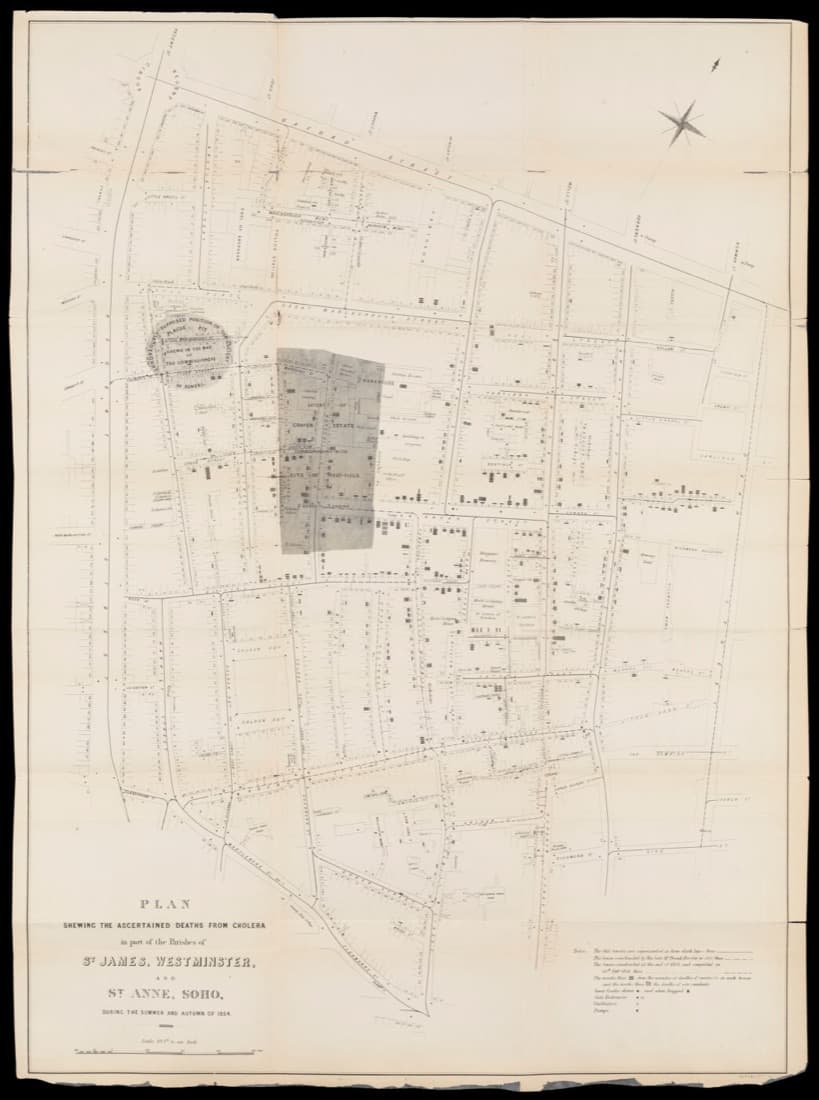
In September 1854 cholera broke out around Broad Street in Soho, London. John Snow, a doctor who had been studying the disease, counted "upwards of five hundred fatal attacks of cholera in ten days".
Snow suspected the water of the public pump in Broad Street. He put his case to the parish Guardians on the evening of 7 September, and the handle of the pump was removed the next day. By then, as Snow himself wrote, the number of new cases had already fallen.
The vestry of the parish of St James, Westminster, set up a Cholera Inquiry Committee, which began work on 25 November 1854. Snow joined it, and so did Henry Whitehead, a local curate. In April 1855 Whitehead learned that a baby at 40 Broad Street had fallen ill just before the outbreak. The Committee found that water from the baby's washing had been emptied into a cesspool whose brickwork was "in the condition of a sieve".
In July 1855 the Committee reported that the outbreak was "in some manner attributable to the use of the impure water of the well in Broad Street". This plan comes from that report. It is not Snow's own map: it is founded on the map in Edmund Cooper's report to the Commissioners of Sewers, and marks the deaths house by house alongside the sewers, gratings and pumps. Snow, who drew his own maps of the outbreak, is seen today as one of the founders of epidemiology.
About the work
- Made by
- Cholera Inquiry Committee, parish of St James, Westminster
- Date
- 1855
- Technique
- Lithographed map, a folded plate in the Committee's report, printed by Day & Son
- Collection
- Wellcome Collection, London
Sources
- Plan showing the ascertained deaths from cholera in part of the parishes of St. James, Westminster Wellcome Collection
- Report on the cholera outbreak in the parish of St. James, Westminster (1855) Wellcome Collection
- Report of the Cholera Inquiry Committee (transcription) John Snow Archive, Michigan State University
- Snow and the pump handle John Snow Archive, Michigan State University
- The Broad Street pump outbreak UCLA Fielding School of Public Health
- On the Mode of Communication of Cholera (extracts) UCLA Fielding School of Public Health
- Henry Whitehead (1825–1896) Wellcome Collection
- John Snow, cholera and the Broad Street pump London Museum
Next story
 PlaqueA note left on the MoonThe steel plaque Apollo 11 left on the Moon in July 1969: two hemispheres, four signatures and "We came in peace for all mankind".1969Read the story