A note left on the Moon
Jack Kinzler ran the Technical Services Division at NASA's centre in Houston. When the question came up of what Apollo 11 should leave on the Moon, he arrived with two ideas, a plaque and a flag. With his assistant chief, David McCraw, he made the first prototype of the plaque.
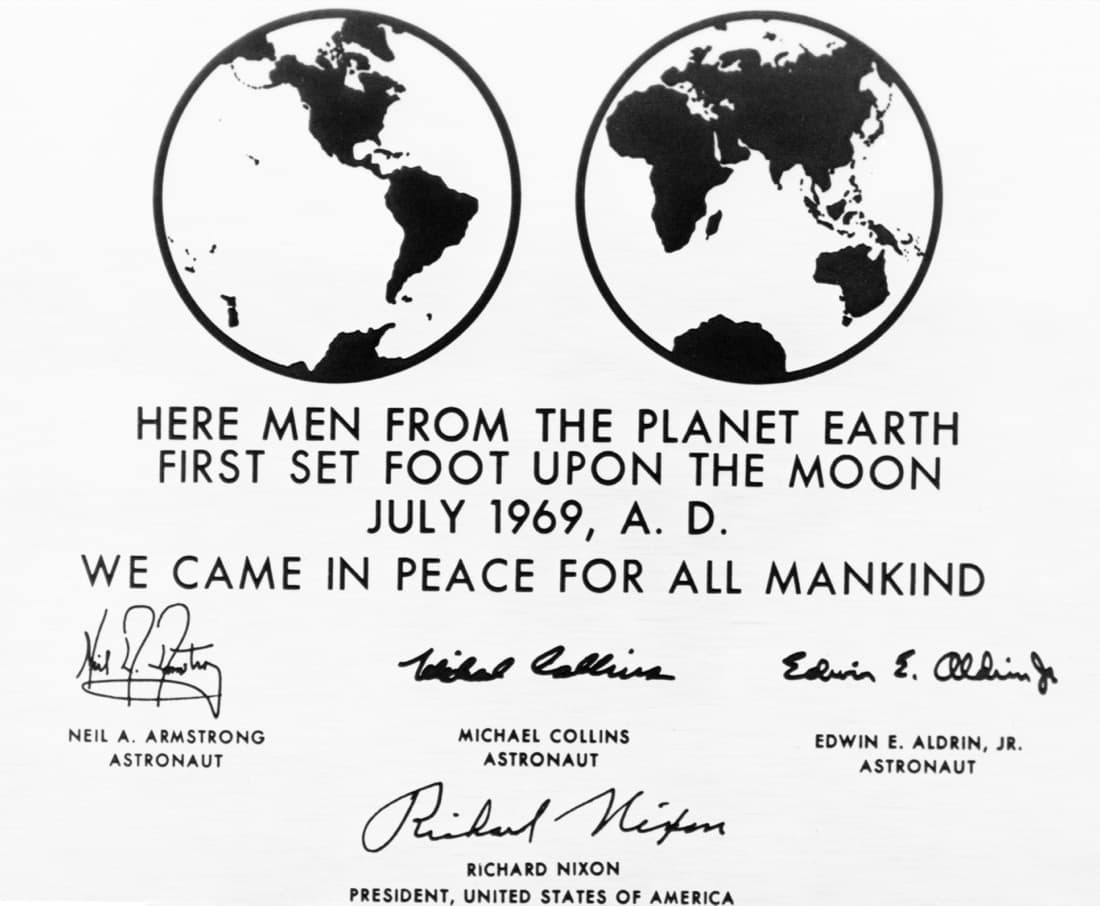
The finished plaque was stainless steel, nine by seven and five-eighths inches, slightly curved, and fixed to the front landing leg of the lunar module Eagle. It shows the Earth's two hemispheres and the words "Here men from the planet Earth first set foot upon the Moon, July 1969, A. D. We came in peace for all mankind", with the signatures of the three astronauts and President Richard Nixon. It was fitted only hours before launch, with the lunar module already on top of the Saturn V.
During the moonwalk Neil Armstrong read it aloud for the people at home: "First there's two hemispheres, one showing each of the two hemispheres of the Earth." He added that it carried the crew's signatures and the signature of the President of the United States.
When the astronauts left, Eagle's descent stage stayed behind with the plaque on it, creating, in the words of the National Air and Space Museum, a permanent memorial on that spot. The descent stage can still be seen in pictures from lunar orbit. The image here is NASA's photograph of a replica, taken before the flight.
About the work
- Made by
- NASA; signed by Neil Armstrong, Michael Collins, Edwin Aldrin and Richard Nixon
- Date
- 1969
- Technique
- Stainless steel; shown in NASA's photograph of a replica, July 1969
Sources
- Replica of the Apollo 11 lunar plaque (S69-39334) NASA
- NASA news release 69-83F (13 July 1969) NASA Technical Reports Server
- One small step (Apollo 11 Lunar Surface Journal) Apollo Lunar Surface Journal
- Plaque, Apollo 11 (replica) Smithsonian National Air and Space Museum
- Article on the Apollo 11 flag and plaque, Houston History 6:1 (2008) University of Houston Center for Public History
- Skylab 2: we can fix anything NASA
- Jack Kinzler Linda Hall Library
- Apollo 11 landing site NASA
Next story
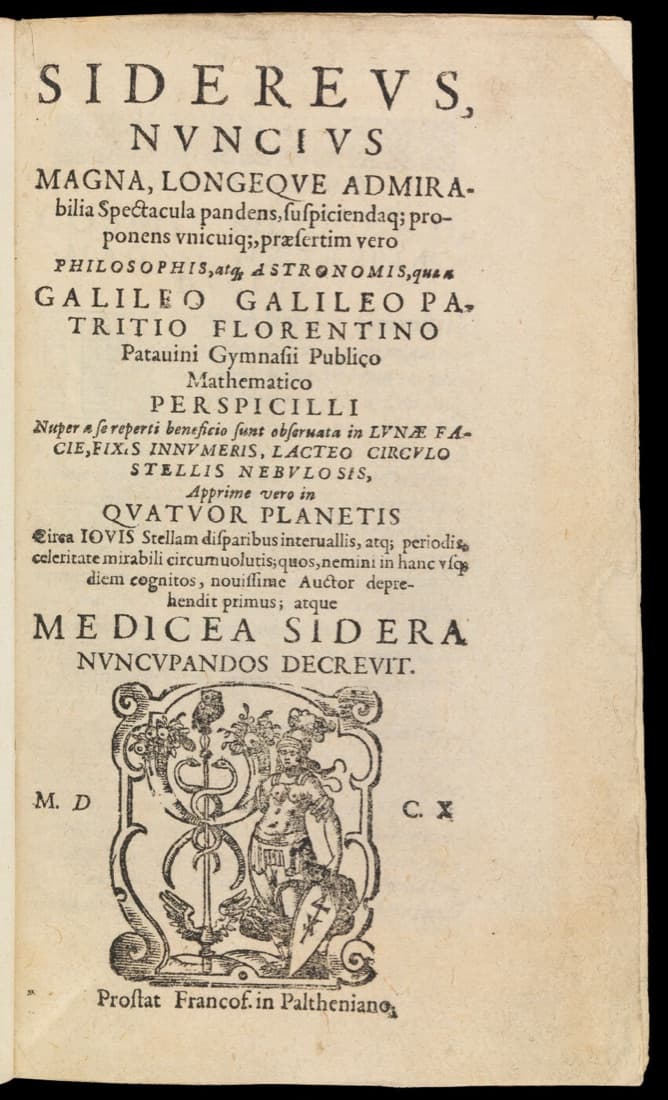 BookThe little book that opened the skyIn 1610 Galileo published what his telescope showed: a rough Moon, countless stars and four moons of Jupiter. This is the Frankfurt printing.1610Read the story