Home, from six billion kilometres away
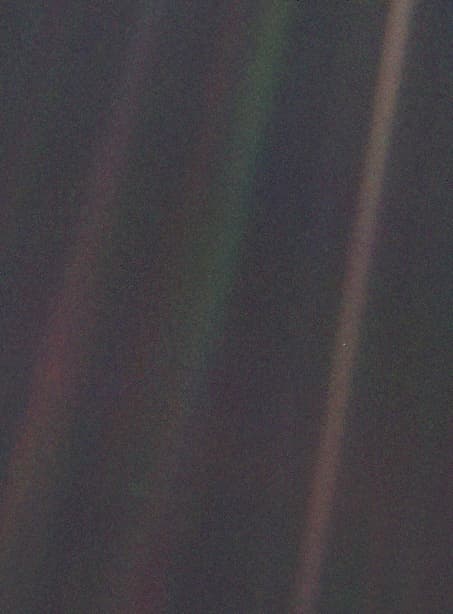
In February 1990 Voyager 1 was 40 times as far from the Sun as the Earth is, about 6 billion kilometres, and some 32 degrees above the plane in which the planets travel. It would not pass close enough to anything else to take pictures again.
Carl Sagan, a member of the Voyager imaging team, had first proposed turning the cameras back toward home in 1981. The idea was turned down several times, because pointing the cameras so close to the Sun could damage them. It took eight years and six requests to get approval.
On 14 February 1990 the spacecraft took 60 frames for a family portrait of the solar system. In this one, taken through violet, blue and green filters, the Earth is a crescent only 0.12 pixels in size. By chance it sits inside one of the rays of sunlight scattered within the camera's optics. The light that made it had left the Earth five hours and 36 minutes earlier.
Thirty-four minutes later Voyager 1 switched off its cameras for good, to save power. Sagan built his 1994 book Pale Blue Dot around the picture: "Look again at that dot. That's here. That's home. That's us."
About the work
- Made by
- Voyager 1, NASA/JPL; requested by Carl Sagan (1934–1996)
- Date
- 1990
- Technique
- Digital image from Voyager 1's narrow-angle camera, through violet, blue and green filters
- Collection
- NASA/JPL-Caltech (PIA00452)
Sources
- Solar System Portrait: Earth as 'Pale Blue Dot' (PIA00452) NASA Photojournal
- Pale Blue Dot Revisited NASA Jet Propulsion Laboratory
- 10 things you might not know about Voyager's famous 'Pale Blue Dot' photo NASA
- Solar System Portrait: 60-frame mosaic NASA Photojournal
- First-ever Solar System family portrait (1990) NASA
- Pale Blue Dot (National Recording Registry essay) Library of Congress
- Carl Sagan archive: finding aid with chronology Library of Congress
Next story
 Poster and programmeA programme that would not sit stillRed and black letters running every way: the poster and programme for the Dada tour of the Netherlands in early 1923.1922Read the story