A programme that would not sit still
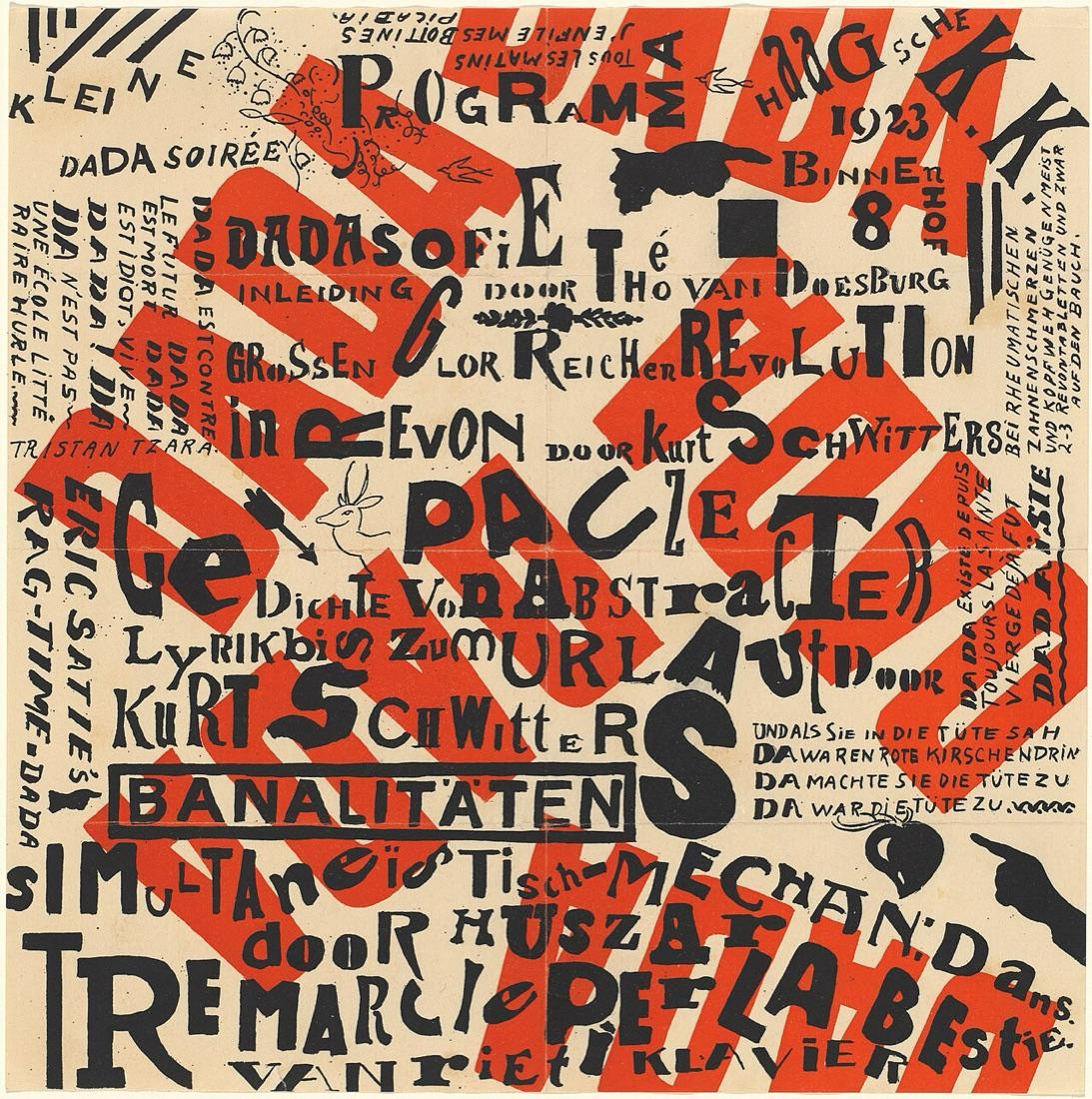
Theo van Doesburg, the Dutch artist who had co-founded the De Stijl movement in 1917, planned a Dada congress. On the advice of the painter Vilmos Huszár, he chose to go on tour instead. Van Doesburg and Huszár were joined by the German artist Kurt Schwitters and by Nelly van Moorsel, who performed as Pétro van Doesburg.
The first evening was planned for 27 December 1922 at the Haagsche Kunstkring in The Hague, but Schwitters did not have valid travel papers in time. The tour opened there on 10 January 1923 and ended with a "Great Dada Evening" at the theatre in Leiden on 14 February.
This sheet was both poster and programme. Its words run in every direction, in red and black and in letters of every size, crowded around the names of the performers and their pieces. Museum De Lakenhal in Leiden notes two versions, suggests the two artists may have made it together, or Van Doesburg alone as early as December 1922, and points to a 1917 poster by Harm Kamerlingh Onnes as a possible inspiration for its lettering.
The evenings drew noisy crowds, and at one of them the police had to step in. A study of the tour in the magazine De Parelduiker calls it a success, above all for publicity, if less so for the money. The University of Iowa Libraries describe the sheet as the masterpiece of Dada typography.
About the work
- Made by
- Theo van Doesburg (1883–1931) and Kurt Schwitters (1887–1948)
- Date
- 1922
- Technique
- Lithograph printed in red and black
Sources
- Annual Report 2011 (acquisition of Kleine Dada Soirée) National Gallery of Art
- Kleine Dada Soirée Museum De Lakenhal, Leiden
- Marco Entrop, on the Dada tour of 1923, De Parelduiker (2002) DBNL
- Kleine Dada Soirée University of Iowa Libraries, Special Collections
- Theo van Doesburg Peggy Guggenheim Collection
- Schwitters, Kurt Neue Deutsche Biographie
Next story
 Woodblock printThe wave that went around the worldHokusai's Great Wave was a woodblock print of the early 1830s, made by the thousand. It is now the most famous Japanese print in the world.1831Read the story