The wave that went around the world
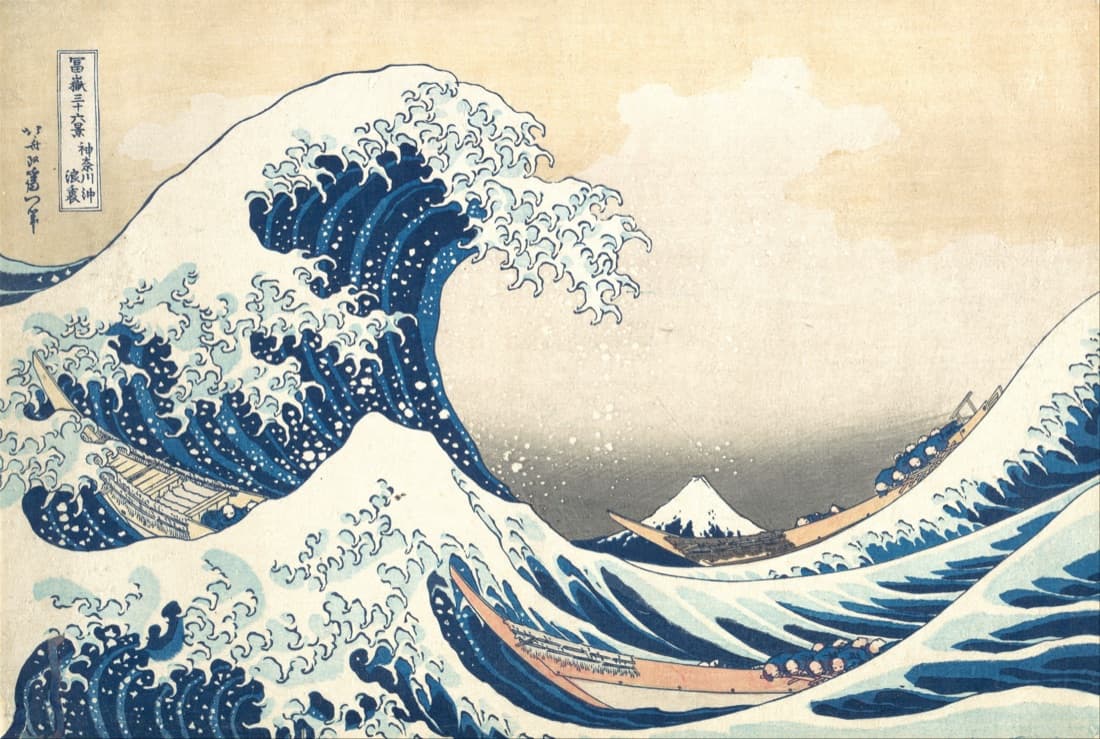
Katsushika Hokusai was born in Edo, today's Tokyo, in 1760. In 1830, at the age of about seventy, he began the project that made him famous around the world: Thirty-six Views of Mount Fuji, a series of colour prints published by Nishimuraya Yohachi. It was popular enough that ten more prints were later added. This one is signed "Hokusai aratame Iitsu hitsu": by the brush of Hokusai, now called Iitsu, one of the many names he used.
Its title is Under the Wave off Kanagawa. A huge wave rises over three oshiokuri-bune, fast boats that carried fresh fish and vegetables to the markets of Edo, their crews crouching low. Mount Fuji, the subject of the whole series, sits far off. In the words of the Met, Hokusai played with perspective to make Japan's grandest mountain appear as a small triangular mound within the hollow of the cresting wave.
Its blues combine indigo with Prussian blue, a synthetic pigment first made in Berlin around 1704 and brought to Japan by Dutch and Chinese traders. From 1829 it was cheap, and Hokusai and his school used it to a striking degree. Prints like this were made in large numbers: experts believe up to 8,000 impressions of the Great Wave were printed. The woodblocks are lost. More than a hundred impressions are known today, four of them at the Met, and the one shown here is an early one, printed before the block of the title cartouche cracked.
Claude Debussy, who loved prints and objects from the Far East, kept the Great Wave in his study and wanted it on the cover of his score La Mer, published in Paris in 1905. The British Museum calls it the most famous Japanese woodblock print in the world, and the Smithsonian's National Museum of Asian Art says it has become virtually synonymous with Japanese art.
About the work
- Made by
- Katsushika Hokusai (1760–1849); published by Nishimuraya Yohachi
- Date
- ca. 1830–32
- Technique
- Woodblock print, ink and colour on paper
Sources
- Under the Wave off Kanagawa (Kanagawa oki nami ura) The Metropolitan Museum of Art
- Capucine Korenberg, The making and evolution of Hokusai's Great Wave British Museum
- Hokusai (exhibition news) Museum of Fine Arts, Boston
- Under the Wave off Kanagawa (1916.685) Harvard Art Museums
- Under the Wave off Kanagawa Tokyo Fuji Art Museum
- Elisabeth West FitzHugh, Marco Leona and John Winter, Pigments in later Japanese paintings (2003) Freer Gallery of Art, Smithsonian Institution
- La Vague d'Hokusai en couverture de La Mer Bibliothèque nationale de France, Essentiels
- Hokusai: making waves Smithsonian National Museum of Asian Art
Next story
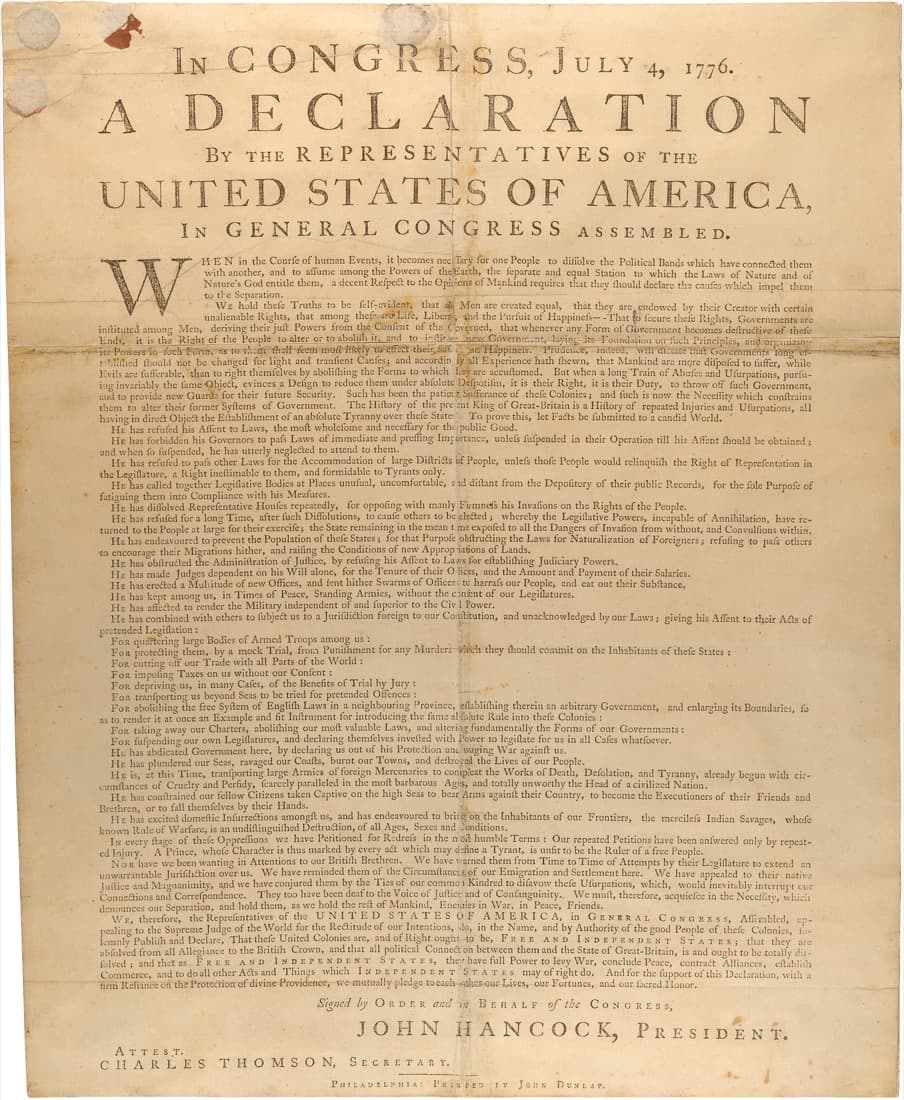 BroadsidePrinted overnight: the first DeclarationOn the night of 4 July 1776 John Dunlap printed the Declaration of Independence as a single sheet. Of perhaps 200 copies, 26 are known today.1776Read the story