What really killed the soldiers
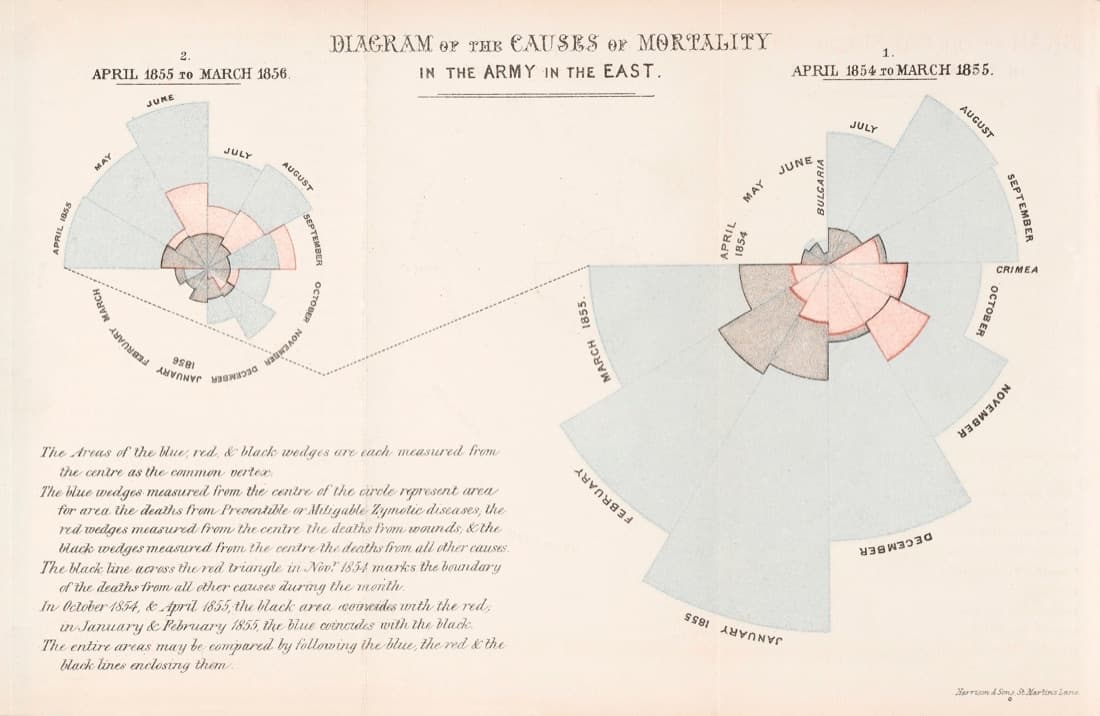
Florence Nightingale was born in Florence in 1820. In October 1854, during the Crimean War, she left London with a party of 38 nurses for the British army hospital at Scutari, near Constantinople, and arrived in early November. By February 1855 the death rate in the hospital had risen to 42 per cent. Nightingale at first blamed poor food. The deaths fell only after a Sanitary Commission sent from London began its works in March 1855, repairing the sewers and improving the ventilation.
Most of the British soldiers who died in the war died of disease, not of their wounds: by one count more than three in four. Back in London, Nightingale lobbied hard for a Royal Commission on the health of the army, set up in 1857, and worked with William Farr, the chief statistician of the General Register Office, to turn the figures into charts. She probably did not draw them herself; the historian Lynn McDonald writes that together they produced charts better than any Farr had published before.
This is the best known of them. Each wedge is a month, April 1854 to March 1855 on the right and the following year on the left, and its area, measured from the centre, stands for that month's deaths: blue for "Preventible or Mitigable Zymotic diseases", red for wounds, black for all other causes. An earlier version had drawn the wedges by length, which she soon saw was misleading; here the areas do the counting. Nightingale did not invent this kind of chart, and the name "coxcomb" often given to it is a later mistake.
It first appeared in 1858 in Notes on Matters Affecting the Health, Efficiency, and Hospital Administration of the British Army, a report she had printed privately. Only a few copies were made; one went to Queen Victoria on 11 October 1858, others to people such as the novelist Elizabeth Gaskell. That year Nightingale became the first woman member of the Statistical Society of London, today the Royal Statistical Society. A permanent Army Sanitary Committee followed, hospitals and barracks were rebuilt, and the army's death rates came down.
About the work
- Made by
- Florence Nightingale (1820–1910)
- Date
- 1858
- Technique
- Colour-printed folding plate by Harrison & Sons, in Nightingale's Notes on Matters Affecting the Health, Efficiency, and Hospital Administration of the British Army (London, 1858)
- Collection
- Wellcome Collection, London
Sources
- Notes on matters affecting the health, efficiency, and hospital administration of the British Army (1858) Wellcome Collection
- Florence Nightingale National Army Museum
- Florence Nightingale: origins Florence Nightingale Museum
- Florence Nightingale (biography) MacTutor, University of St Andrews
- Iris Veysey, A statistical campaign: Florence Nightingale and Harriet Martineau's England and her Soldiers Science Museum Group Journal
- Lynn McDonald, Florence Nightingale, statistics and the Crimean War (JRSS A, 2014) Collected Works of Florence Nightingale, University of Guelph
- Lynn McDonald, Florence Nightingale: the real goods and the oversell (Significance, 2020) Royal Statistical Society
- Michael Friendly and R. J. Andrews, The radiant diagrams of Florence Nightingale (SORT, 2021) SORT, Statistics and Operations Research Transactions
- Pigeonholes and mustard seeds: using data to improve Royal Statistical Society
- Nightingale 2020: the bicentenary of our first female member Royal Statistical Society
- Notes on matters affecting the health, efficiency, and hospital administration of the British Army (Queen Victoria's copy) Royal Collection Trust
- The passionate statistician Florence Nightingale Museum Trust, via the University of York
Next story
 PamphletPlain words for independencePublished anonymously in Philadelphia in January 1776, Thomas Paine's Common Sense made the case for American independence.1776Read the story