The poster that made Lautrec's name
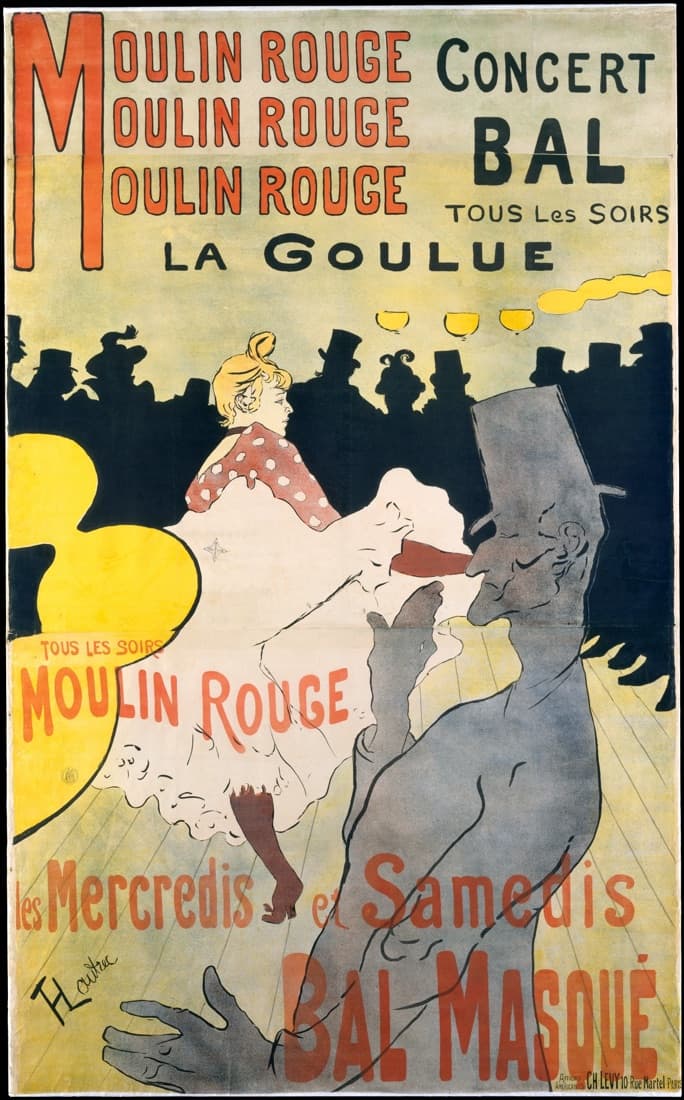
Joseph Oller and Charles Zidler opened the Moulin Rouge dance hall in Montmartre in 1889. That year Jules Chéret, whom the Bibliothèque nationale de France calls the father of the modern poster, made a poster for a ball there.
In 1891 Zidler commissioned a poster to launch the season from Henri de Toulouse-Lautrec, a painter who had never made one. It was his first poster and his first lithograph: four colours across three sheets, nearly two metres tall, printed by the Affiches Américaines of Charles Lévy.
At the centre the star dancer La Goulue, stage name of Louise Weber, kicks up a cloud of white petticoats. In front of her glides the grey silhouette of her partner Valentin le Désossé, "the boneless", who never took money for dancing. The crowd behind them is a row of flat black shapes.
The poster was acclaimed in the French newspapers and soon shown at an avant-garde exhibition in Brussels. The Toulouse-Lautrec Museum in Albi says it made his name known to the general public, and the Rijksmuseum calls it his first and, at the same time, his most famous poster. A catalogue of his prints records six versions.
About the work
- Made by
- Henri de Toulouse-Lautrec (1864–1901)
- Date
- 1891
- Technique
- Lithograph printed in four colours on three sheets
Sources
- Moulin Rouge: La Goulue The Metropolitan Museum of Art
- Affiche Moulin Rouge Musée Toulouse-Lautrec, Albi
- Poster for Le Moulin Rouge Rijksmuseum
- Moulin Rouge, La Goulue Victoria and Albert Museum
- Bal au Moulin Rouge (Jules Chéret, 1889) Victoria and Albert Museum
- L'art est dans la rue Bibliothèque nationale de France
- The great periods Moulin Rouge
- Henri de Toulouse-Lautrec et l'estampe, repères chronologiques Encyclopædia Universalis
Next story
 BroadsideTheses for a debate that never happenedLuther wrote 95 Latin theses on indulgences for a debate in Wittenberg in 1517. Printers spread them; this Nuremberg sheet is one of very few left.1517Read the story