Theses for a debate that never happened
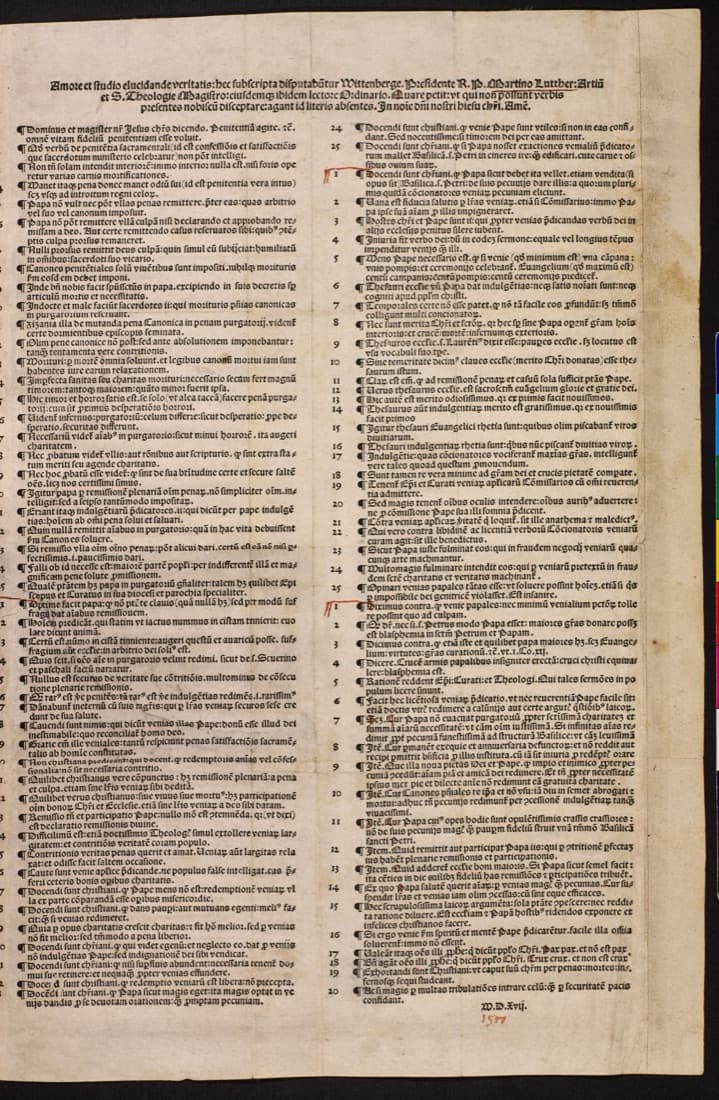
In 1517 Martin Luther was an Augustinian friar and professor of theology at the young university of Wittenberg, in Saxony. In January that year the Dominican Johann Tetzel was appointed to preach an indulgence for the rebuilding of St Peter's in Rome in the lands of Albrecht, Archbishop of Mainz. Albrecht had borrowed from the Fugger bank to pay Rome for his office, and he was allowed to keep half of what the indulgence raised.
On 31 October 1517 Luther sent the archbishop a letter, and with it ninety-five theses in Latin: statements on the power of indulgences, to be argued over in an academic disputation in Wittenberg. The letter survives in a Swedish archive. Whether he also nailed the theses to the door of the Castle Church is still debated. Philipp Melanchthon first told the story after Luther's death in 1546, and he was not in Wittenberg in 1517; a note by Luther's assistant Georg Rörer from the 1540s says the theses were posted on the doors of Wittenberg's churches. The disputation itself never took place.
Handwritten copies travelled fast, and before the year was out printers in Leipzig, Nuremberg and Basel had set the theses in type, none of them giving their name. Leipzig and Nuremberg printed them as two-column placards, Basel as a small pamphlet. This is the Nuremberg sheet, from the shop of Hieronymus Höltzel, which counts the theses three times up to 25 and once up to 20. The chronicler Friedrich Myconius, who lived through it, wrote that within fourteen days they had gone through all of Germany. Luther himself regretted that theses meant for a few scholars had reached the people.
About 300 copies of each printing are thought to have been made; only seven copies of the two placards are known today. This one was found in a London bookshop in 1891 by the director of Berlin's museum of prints and drawings and given to the Royal Library, now the Staatsbibliothek zu Berlin. It still shows the folds of 1517. The theses are generally seen as the beginning of the Reformation, and by January 1521 Luther had been excommunicated. In 2015 UNESCO added this sheet to its Memory of the World register.
About the work
- Made by
- Martin Luther (1483–1546); printed in Nuremberg by Hieronymus Höltzel
- Date
- 1517
- Technique
- Printed broadside, a single sheet in two columns
Sources
- Disputatio pro declaratione virtutis indulgentiarum, Nuremberg 1517 (catalogue record and digitised copy) Staatsbibliothek zu Berlin
- Michaela Scheibe, 95 oder 87? Martin Luthers Disputationsthesen (2016) Staatsbibliothek zu Berlin
- Nur in Berlin: die einzige Luther-Ausstellung mit allen drei Thesen-Drucken von 1517 Staatsbibliothek zu Berlin
- Beginning and the early development of the Reformation initiated by Martin Luther UNESCO Memory of the World
- Axel Gotthard, Schlaglicht 1517: der sogenannte Thesenanschlag Bundeszentrale für politische Bildung
- Thomas Kaufmann, Von den 95 Thesen zum Augsburger Religionsfrieden Bundeszentrale für politische Bildung (APuZ)
- Luther, Martin Neue Deutsche Biographie
- 95 Thesen Evangelische Kirche in Deutschland
- Erwin Iserloh, Luthers Thesenanschlag: Tatsache oder Legende? (1962) Université de Fribourg
- Timothy J. Wengert, introduction to The Annotated Luther, volume 1 Fortress Press
- Stefan Rhein, Thesenanschlag als Selbstfindung (2016) Die Politische Meinung, Konrad-Adenauer-Stiftung
- The image of a fractured church: Martin Luther and the 95 Theses at 500 years Pitts Theology Library, Emory University
Next story
 PaintingA town inside a wheel in spaceDon Davis's 1975 painting for NASA Ames shows the inside of a ring-shaped space settlement designed for 10,000 people.1975Read the story