Death takes the electric tram
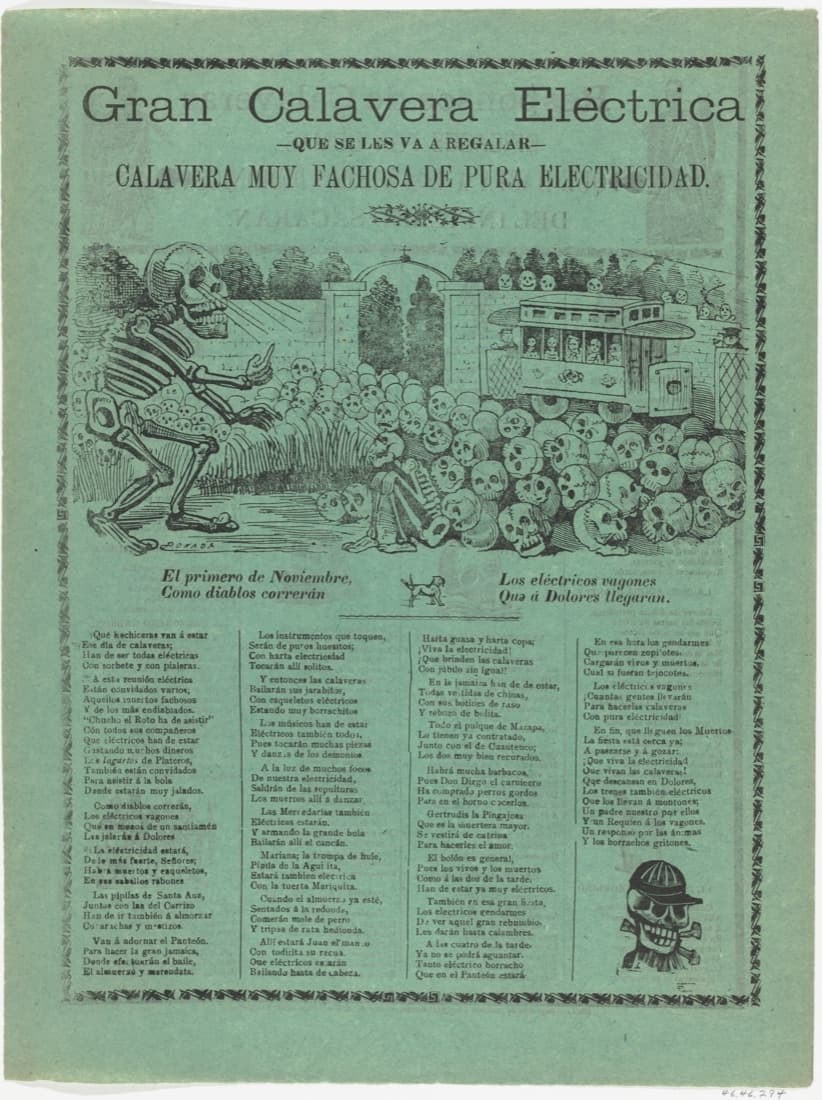
José Guadalupe Posada was born in Aguascalientes, Mexico, in 1852, and at sixteen went to learn lithography in the workshop of Trinidad Pedroza. In the late 1880s he moved to Mexico City and went to work for Antonio Vanegas Arroyo, whose press, founded in 1880, sold cheap broadsides: news, ballads, saints' lives and calaveras. Posada made thousands of engravings for it. Printed on coloured tissue paper, the sheets sold for a centavo, and the pictures mattered, because poverty and illiteracy were widespread.
Calaveras were the press's offering for the Day of the Dead, celebrated on 1 and 2 November: comic verses that treat the living, from friends and relatives to politicians, as if they were already dead, illustrated with skeletons. Posada did not invent the form; some credit the engraver Manuel Manilla, who worked for the same press. But as the Library of Congress puts it, Posada popularized the calaveras as a national symbol in Mexico.
This one takes on the newest thing in town. Mexico City's electric trams were inaugurated on 15 January 1900, and the historian Mario Camarena lists an electric line to the Dolores cemetery opening that 1 November. Under the title, a giant skeleton hypnotises a heap of skulls at the cemetery gate while a tram full of skeletons rolls by, and the verse promises that on the first of November the electric cars will run like devils all the way to Dolores. The Met dates the design to 1900; the copy shown here has another calavera printed on its back with the imprint 1907, so this sheet was printed, or printed again, that year.
Posada died poor in Mexico City on 20 January 1913 and was buried in a common grave. The oldest surviving print of his best-known skeleton, an elegant lady first called the Calavera Garbancera, dates from that year, nine months after his death. In 1947 Diego Rivera painted her arm in arm with Posada in his mural Dream of a Sunday Afternoon in the Alameda Central, and gave her the name she has had ever since: La Catrina. The word is already in this calavera, where one verse has a woman who "se vestirá de catrina": she will dress up as a fine lady.
About the work
- Made by
- José Guadalupe Posada (1852–1913); published by Antonio Vanegas Arroyo
- Date
- 1900
- Technique
- Zincograph, type-metal engraving and letterpress on green paper
Sources
- The grand electric skeleton (Gran Calavera Eléctrica), recto and verso The Metropolitan Museum of Art
- Día de los Muertos: exploring images from the Day of the Dead Library of Congress, Teaching with the Library blog
- José Guadalupe Posada's lively calaveras and enduring legacy Library of Congress
- Breathing life into the Day of the Dead: the calaveras of José Guadalupe Posada Library of Congress, Picture This blog
- Euforia internacional por José Guadalupe Posada Secretaría de Cultura, Mexico
- La Secretaría de Cultura y el INBAL recuerdan a José Guadalupe Posada Secretaría de Cultura, Mexico
- La resignificación de la imagen de la calavera en México Archivo General de la Nación, Mexico
- La Imprenta Vanegas Arroyo, perfil de un archivo familiar (2013) Revista de Literaturas Populares, UNAM
- El día de muertos en México Flores de Nieve, CEPE, UNAM
- Día de Muertos: una conmemoración tradicional SIPINNA, Government of Mexico
- El primer tren eléctrico en Tacubaya Fototeca Nacional, INAH
- Mario Camarena, El tranvía en época de cambio (Historias 27, 1992) INAH
- María Guadalupe Reyes García, La Catrina, de José Guadalupe Posada (Vita Brevis 13, 2018) INAH
- José Guadalupe Posada, autor y padre de la célebre Catrina Secretaría de Relaciones Exteriores, Mexico
- Recorridos especiales por el mural Sueño de una tarde dominical en la Alameda Central Secretaría de Cultura, Mexico
Next story
 MapCounting the dead, street by streetThe 1855 map of cholera deaths in Soho, made for a parish inquiry into the outbreak that John Snow had traced to the Broad Street pump.1855Read the story